The Myth of the AI Rowan
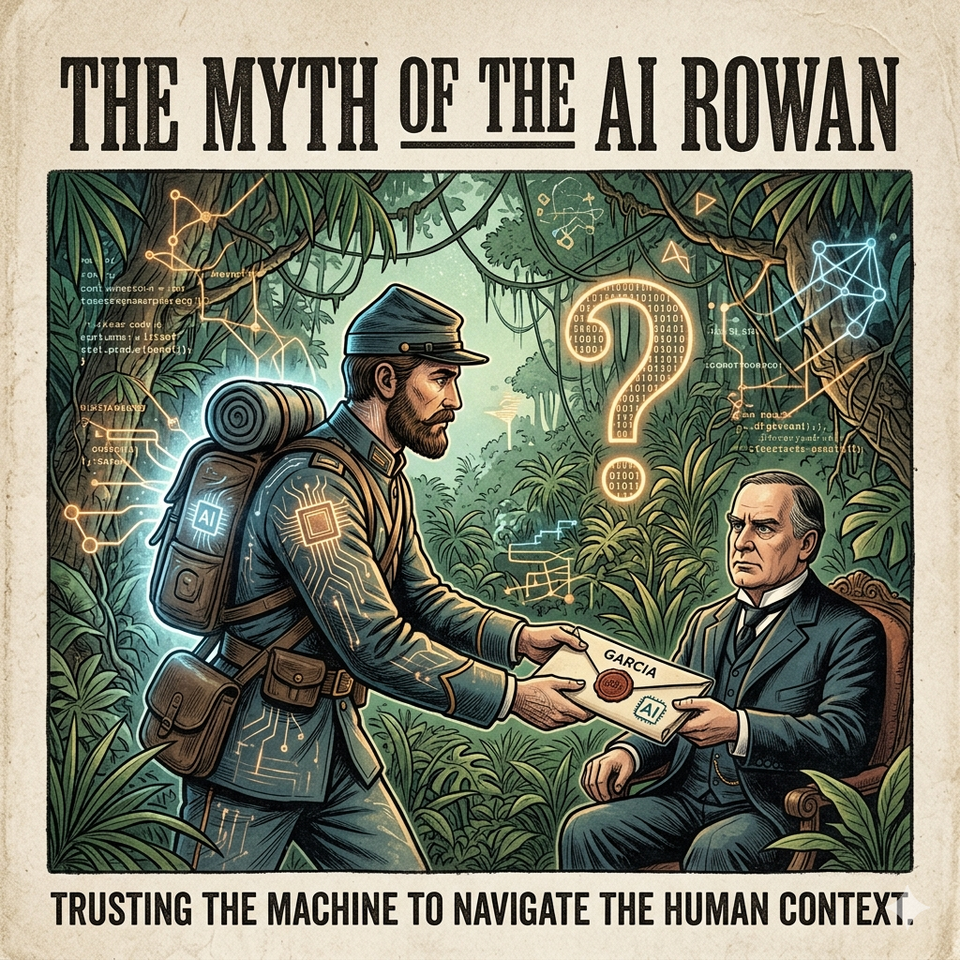
In 1899, Elbert Hubbard wrote A Message to Garcia, an essay that would become the holy text of industrial-era management. The premise was simple: President McKinley needed to send a letter to a rebel general hidden deep in the Cuban jungle. He handed the message to a soldier named Rowan. Rowan didn’t ask where the general was, how to get there, or what the weather was like. He just took the letter and disappeared into the brush. Three weeks later, the message was delivered.
For over a century, managers have used Rowan as the gold standard of the ideal subordinate. Don't ask questions. Don't demand context. Just figure it out. Act.
With the dawn of the LLM era, the tech industry thought it had finally engineered the ultimate, tireless Rowan. We look at a top-tier model, hand it a vague directive, and expect it to plunge into the digital jungle and return with a flawless implementation.
We treat AI like Rowan. But AI is not Rowan. And our blindness to our own tacit context is turning expensive compute into an unprecedented waste of engineering time.
The Flaw of the Silent Context
The magic of Rowan wasn't just that he was brave; it was that he was human. He possessed an implicit, unwritten understanding of physical reality, human nature, and military logic. When he encountered a swamp, he didn’t need a prompt to tell him to walk around it. It was tacit knowledge, so deeply ingrained it went unsaid.
Large Language Models do not live in our reality. They live in a mathematical lattice of token probabilities. When you give them a task, we do not intentionally starve them of information. Instead, we fail to perceive just how much implicit context we are running in our own heads.
Consider a failing test suite. A test that should always pass suddenly blinks red. The temptation is to copy the failing test, paste it into a prompt box of a top-tier, costly model, and wait for the diagnosis.
The AI, acting like a dutiful Rowan, immediately returns a highly professional, technically articulate list of possibilities. It suggests race conditions in the mock layers or subtle lifecycle mismatches in the test runner.
The solutions look mathematically elegant. They are also completely wrong.
Because the AI doesn't know that a colleague sitting three desks away started their own heavy test runner at the exact same microsecond, causing a transient network collision. To the human engineer, the environment is an obvious, felt reality. To the machine, it does not exist. Stripped of this unperceived ecosystem, the "Rowan" of code simply hallucinates a sophisticated solution to a phantom problem, leaving the developer to waste hours chasing ghosts in a clean codebase.
Functional Rightness, Semantic Wrongness
This blind spot infects the very logic of our software specifications.
When a human engineer reads a poorly written specification document, they use a lifetime of domain experience to read between the lines. If a data structure name has a glaring typo, the human brain seamlessly corrects it based on the surrounding semantics. The context is so obvious it goes unremarked.
An LLM does not cross-examine your unstated intent. It has no access to the unspoken consensus of your engineering team. If you feed a flawed specification document directly into a high-end model, it will execute the literal tokens with terrifying efficiency.
The AI will build the entire system around the flaw. It will write neat, modular code. It will generate comprehensive documentation. It will even generate a robust suite of unit tests that pass flawlessly—because the tests are validating the exact same flawed assumptions embedded in the implementation.
The result is a masterpiece of technical compliance that is totally useless. The code compiles, it runs, and it lies.
The Cost of Cheap Delegation
The industrial-era interpretation of A Message to Garcia praised blind execution. But in software engineering, blind execution is an anti-pattern.
When McKinley gave Rowan the letter, he was delegating a task, not a thought process. When we drop raw specs and unstructured logs into an LLM and expect a turnkey solution, we aren't practicing efficient delegation; we are practicing abdication.
We are hoping that the sheer scale of modern parameters can substitute for architectural intent and environmental awareness. It cannot.
AI can write the code, but it cannot own the invariants. It cannot guess the unspoken context of your legacy infrastructure, your team's deployment schedules, or the human errors hidden within your documentation.
If we continue to treat AI as a blind Rowan—trusting it to deliver without giving it the map, the compass, or the true context—we will continue to spend our precious engineering hours debugging beautiful, expensive, highly coherent garbage.
The machine will do the thing. But it is still up to us to make sure it's the right thing.


Comments ()